
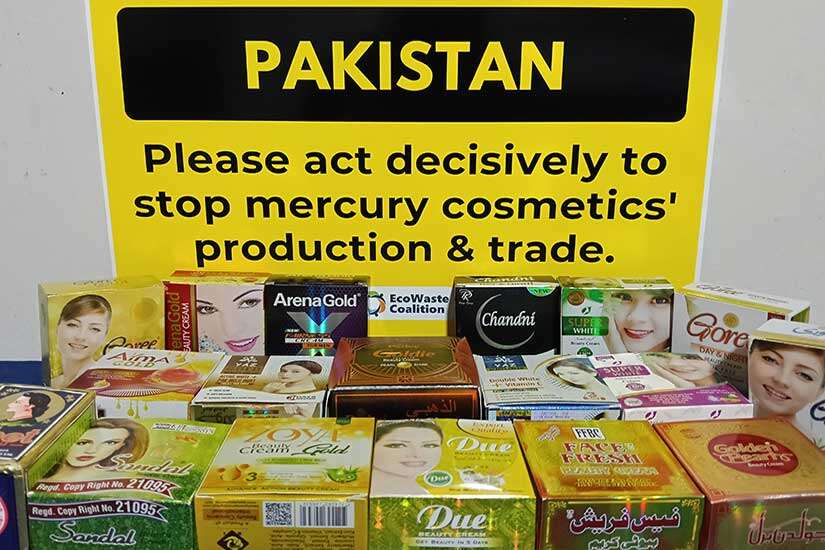
(Group reveals mercury up to 33,970 ppm in 18 out of 20 Pakistan-made fairness creams)
Quezon City. Ahead of World Health Day on April 7, the toxics watchdog group EcoWaste Coalition took the Government of Pakistan to task for its apparent failure to enforce the global ban on mercury-added cosmetics.
The Minamata Convention on Mercury, ratified by Pakistan and the Philippines in 2020, set a 2020 phase-out deadline for the manufacture, export, and import of mercury-added cosmetics, such as skin lightening products. In 2023, the phase-out deadline was adjusted to 2025 to address evident gaps and loopholes hindering the effective implementation of the ban.
The EcoWaste Coalition, which has been exposing dangerous skin lightening products with mercury additives since 2011, deplored the persistent violation of the global ban on mercury-added cosmetics following its detection of outrageous levels of mercury up to 33,970 parts per million (ppm) in 18 out of 20 newly-purchased products labeled as made in Pakistan, including eight products bearing the Pakistan Standards mark.

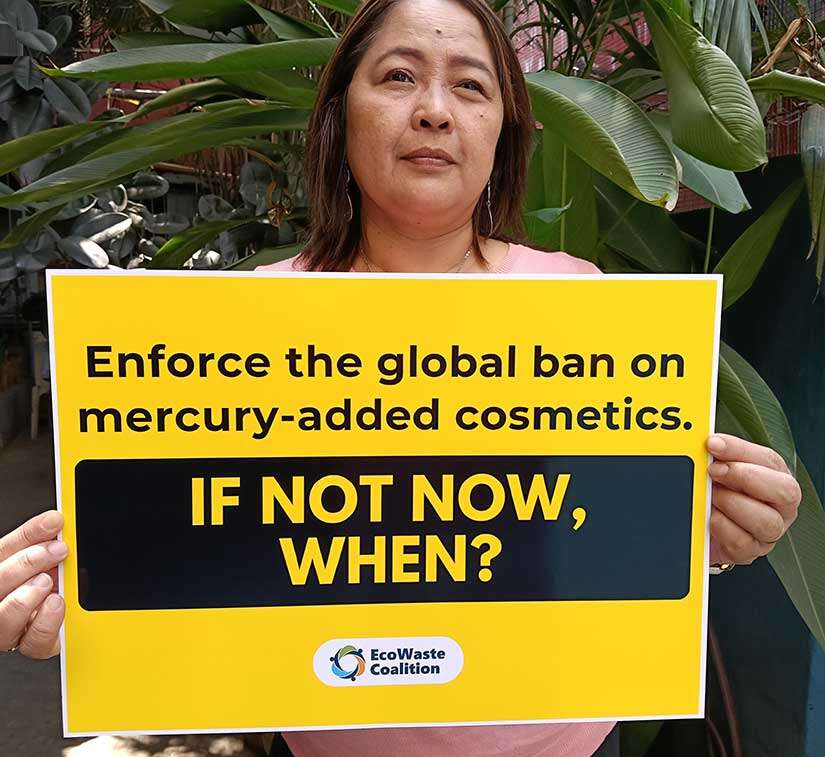
“The unrelenting manufacture of so-called beauty creams in Pakistan with hidden mercury content is unlawful and unacceptable. Exported with impunity and offered for sale in the marketplace, these highly contaminated products pose a serious threat to the health of women and their families, especially the young children,” said Aileen Lucero, National Coordinator, EcoWaste Coalition. “We join the over 20 international health and environmental organizations that have earlier called on Pakistan to stop the domestic production and global trade of these dangerous cosmetics with mercury. If not now, when?”
“I am thankful to EcoWaste Coalition for vigilantly watching over women’s health in campaigning tirelessly against mercury-laced cosmetics, particularly skin-whitening products. Mercury is purported to hasten the skin lightening effect of cosmetics by inhibiting the production of melanin– our body’s natural sunscreen,” said feminist Jean Enriquez, Executive Director, Coalition Against Trafficking in Women – Asia Pacific (CATW-AP). “Manufacturers, importers, distributors, and sellers continue to sell such cosmetics targeting Filipinas and other women who are clueless about the long-term health effects of mercury in their bodies and the ecosystems.”
From March 1 to 31 this year, the EcoWaste Coalition, as part of its observance of the National Women’s Month, purchased a total of 20 products manufactured by 14 Pakistan cosmetic companies that claim to lighten the skin tone and remove signs of ageing. Thirteen of these products were purchased from third-party online sellers at Lazada and Shopee, and seven from beauty product stalls operating in Pasay City. Five of the products are marked “export quality.”
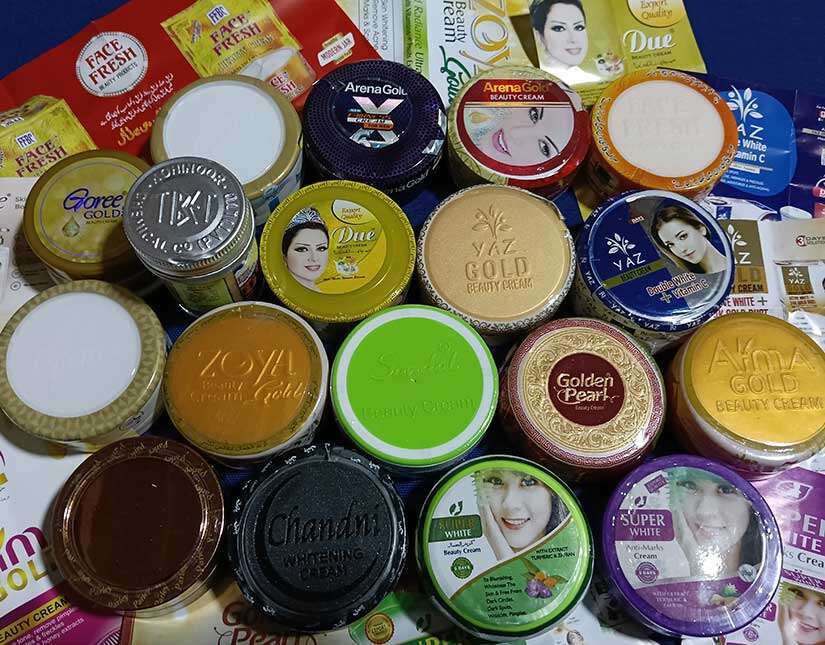
Of the 20 products purchased and analyzed using a handheld Olympus Vanta M Series X-Ray Fluorescence (XRF) device, 18 contained mercury up to 33,970 ppm, of which 11 had mercury above 20,000 ppm. All the 18 products had mercury way in excess of the 15 ppm limit for waste contaminated with mercury, and should be declared hazardous waste. Also, 13 of the mercury-tainted products were manufactured in 2025, two in 2024, and three in 2023, way past the 2020 and 2025 phase-out deadlines.
The discovery of highly contaminated skin lightening products sparked fresh calls for parties to the Minamata Convention on Mercury, such as Pakistan, to firmly enforce the ban on mercury in cosmetics. It also reinforced calls for women to embrace their natural skin color and to resist colorism and objectification, and for erring companies to be held accountable.
“I call on women to resist the pressures from patriarchal, racist, and capitalist culture, to resist succumbing to the use of cosmetics that belittle us, that reduce our worth to our looks. This women’s month and always, we have to resist by believing and knowing that our worth goes beyond our physical attributes,” said Enriquez.
“As Filipinas, we have to resist messaging by corporations and merchants that our brown color can be equated to lower status, or to objectification. Buo ang ating pagkatao, tayo ay may talino, galing, lakas, puso at lalim. Hindi hiwalay ang ating katawan sa ating lalim at kaluluwa. We have to value ourselves as persons equal to men, and we have to defy corporate interest to profit from our historical subjugation,” she pointed out. “Make these companies accountable. Uplift all women, regardless of color.”
The analyzed products with the highest concentrations of mercury include: Yaz Beauty Cream Double White + Vitamin C with 33,970 ppm; Arena Gold Beauty Cream, 31,370 ppm; Arena Gold New Fairness Cream for Men, 30,130 ppm; Yaz Gold Beauty Cream Active White + 24K Gold Dust, 29,870 ppm; Goree Day & Night Beauty Cream, 28,640 ppm; Chandni Day & Night Whitening Cream (black packaging), 28,330 ppm; Goree Beauty Cream with Lycopene, 27,600 ppm; Goree Gold 24K Beauty Cream, 25,760 ppm; Zoya Gold Beauty Cream, 22,090 ppm; Aima Gold Beauty Cream, 21,720 ppm; and Face Fresh Beauty Cream, 20,510 ppm.
Also found adulterated with mercury were: Golden Pearl Beauty Cream, 17,580 ppm; Due Beauty Cream, 16,590 ppm; Parley Goldie Advanced Beauty Cream, 15,750 ppm; Sandal Beauty Cream, 13,900 ppm; Super White Anti-Marks Cream, 1,214 ppm; Super White Beauty Cream, 852 ppm; and Tibet Snow, 75 ppm.
Mercury was not detected in the analyzed Face Fresh Cleanser Cream and Glow & Clean Beauty Cream.
The Food and Drug Administration (FDA) of the Philippines has already issued public health warnings on the three variants of Goree Beauty Cream, Golden Pearl Beauty Cream, Parley Goldie Advanced Beauty Cream, and Sandal Beauty Cream. It has yet to advise the public on the adverse effects of using the other products with mercury content, as reported by the EcoWaste Coalition to the FDA on April 1, 2026.
References:
https://www.unep.org/globalmercurypartnership/our-work/mercury-products/eliminating-mercury-skin-lightening-products
https://www.unep.org/globalmercurypartnership/news/blogpost/pakistan-faces-global-pressure-walk-talk-toxic-skin-whitening-creams
https://www.personalcareinsights.com/news/pakistan-mercury-skin-creams.html


